

al-Mabādīʾ al-ʿAshara: Re-rooting Education in Revelation
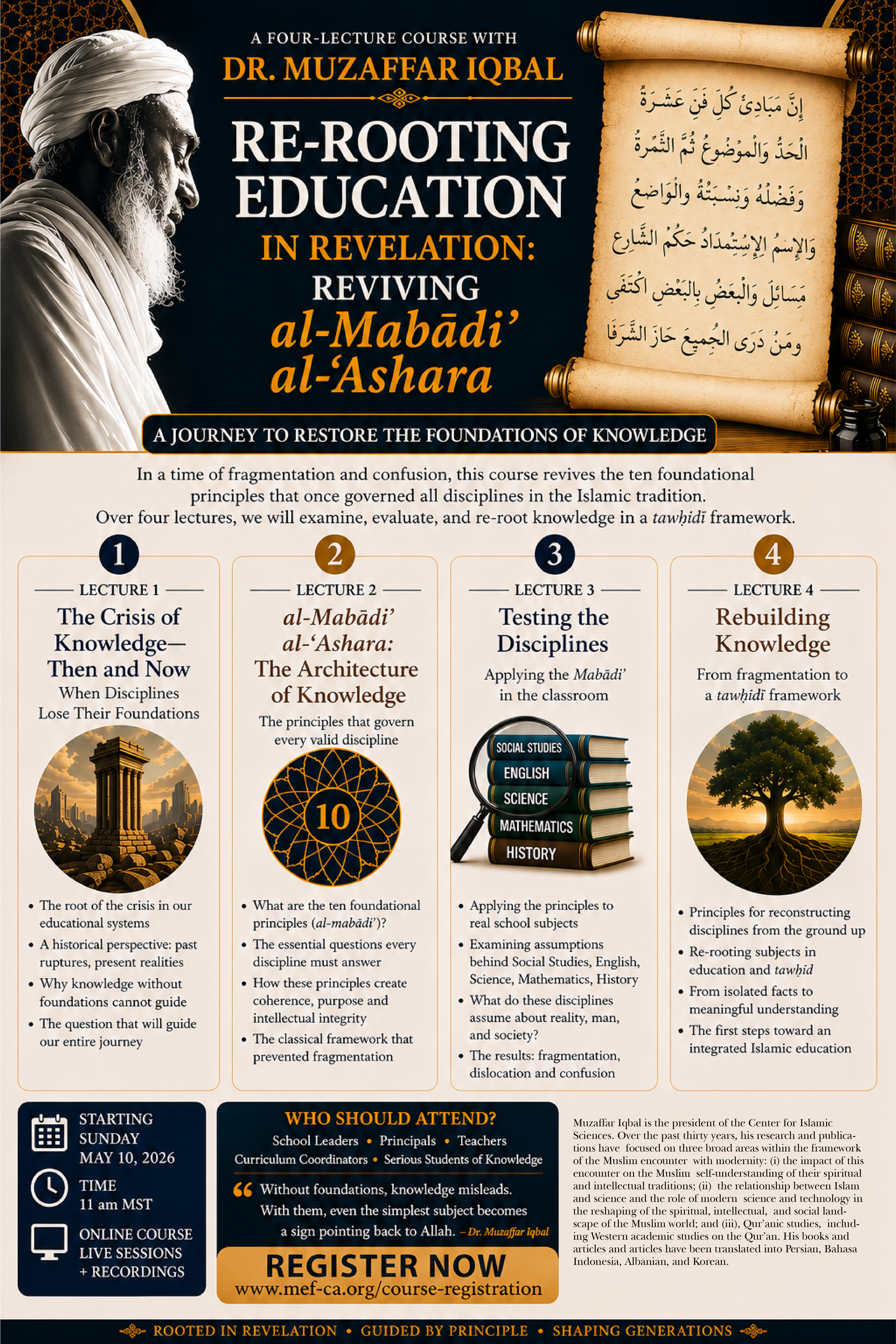
al-Mabādīʾ al-ʿAshara: Re-rooting Education in Revelation
Dr. Muzaffar Iqbal
5-Online weekly lectures, starting Sunday, May 10, 2026, at 11 am MST.
Recordings available each week.
This 4-lecture course revives the centuries-old tradition of framing every branch of knowledge within the epistemic frame of revelation. Al-Mabādiʾ al-ʿAshara—the ten foundational principles, used by classical Muslim scholars to define, discipline, and order knowledge first emerged at a time of intense intellectual encounter and epistemic disruption with Greek knowledge. These principles ensured that new knowledge was neither rejected reflexively nor absorbed uncritically but integrated with clarity and hierarchy; they helped to keep knowledge rooted in revelation. Today, we live in an age where Islamic tradition faces a far greater challenge.
We live in an age when education fragments disciplines and divorces knowledge from higher principles. By employing al-Mabādiʾ al-ʿAshara we can learn to restore the essential epistemic grammar. Participants will learn how the specific branch of knowledge they are teaching is properly defined, what questions legitimately belong to it, how it relates to other sciences, and what ethical accountability governs its pursuit.
Designed for teachers, scholars, and institutional leaders, this course provides the conceptual foundations necessary to move from Muslim schools to truly Islamic education—where knowledge is ordered, purposeful, and rooted in tawḥīd.
al-Mabādiʾ al-ʿAshara
Re-rooting Knowledge in Revelation
A 4-Lecture online Course with access to recordings
Another course in the MEF initiative: “From Muslim to Islamic Schools”
We live in a time of profound confusion.
We teach subjects—but no longer ask what they are.
We transmit knowledge—but no longer ask where it comes from.
We design curricula—but no longer ask what they lead to.
And so knowledge fragments.
Education loses its center.
Confusion becomes the norm.
What has been lost are the foundations of knowledge.
For centuries, no discipline in the Islamic tradition was taught without first being grounded in ten essential principles:
al-Mabādiʾ al-ʿAshara
The Ten Foundational Principles of Every Discipline
al-Ḥadd (Definition): What is this discipline, and what are its boundaries?
al-Mawḍūʿ (Subject): What does it study?
al-Thamara (Fruit): What does it produce in the learner?
Faḍluhu (Merit): Why does it matter, and what is its rank?
Nisbatuhu (Relation): How does it relate to other fields of knowledge?
al-Wāḍiʿ (Founder): Who established it, and on what authority?
al-Ism (Name): What is its proper identity?
al-Istimdād (Sources): From where does it derive its knowledge?
Ḥukm al-Shāriʿ (Legal Ruling): What is its standing before Allah?
al-Masāʾil (Core Questions): What issues does it address?
Today, these questions are no longer asked.
This course restores them.
By the end of this course, the participants will be able to:
Understand the historical conditions that necessitated the formulation of the mabādīʾ.
Articulate each of the ten principles as an operative epistemic rule.
Diagnose contemporary epistemic confusion using the mabādīʾ framework.
Apply the mabādīʾ to core subjects in diverse contemporary educational contexts.
Distinguish between legitimate synthesis and epistemic distortion.
Course Structure (4 Lectures, every Sunday, starting May 10, 2026, at 11 am MST)
Zoom link for registered participants=al-Mabādīʾ al-ʿAshara Course
Time: May 10, 2026 11:00 AM Mountain Time (US and Canada)
Join Zoom Meeting
https://zoom.us/j/96972256615?pwd=cc1sKCPS8uKzIWuFpZmoufwZf1gNUz.1
Meeting ID: 969 7225 6615
Passcode: 260510
Lecture 1: Sunday, May 10, 2026, 11 am MST
Revelation, Knowledge, Civilization
Background—Clarifications—Key Terms
Lecture 2: Sunday, May 17, 2026, 11 am MST
The First Crisis of Knowledge
The first three centuries: From the passing of the Prophet, upon him blessings and peace, to the emergence of a monumental civilization based on knowledge.
How the crisis began?
The nature of the first epistemic shock
Lecture 3: Sunday, May 24, 2026, 11 am MST
al-Mabādiʾ al-ʿAshara: The Architecture of Knowledge
The ten principles that govern every valid discipline
A recovery of the foundational framework that once structured all sciences—restoring the essential questions that must precede every act of teaching.
Lecture 4: Sunday, May 31, 2026, 11 am MST
Testing the Disciplines
Applying the Mabādiʾ in the Classroom
A direct examination of modern subjects—Social Studies, English, Science, and Mathematics—revealing their assumptions, limitations, and underlying worldviews.
Lecture 5: Sunday, June 07, 2026, 11 am MST
Rebuilding Knowledge
From Fragmentation to a Tawḥīdī Framework
Moving from critique to reconstruction—this fifth and last session of the course outlines how disciplines can be re-rooted in revelation and restored to their proper purpose. This framework is not a closed system. It is a discipline of attention, humility, and responsibility. Its success is not measured by expansion, but by clarity; not by novelty, but by soundness.
May Allah Most High grant us the sight to see foundational cracks in our Muslim education system, grant us tawfīq and bless those who teach with insight, learn with sincerity, and order knowledge with its true right: the tawḥīdī framework.