

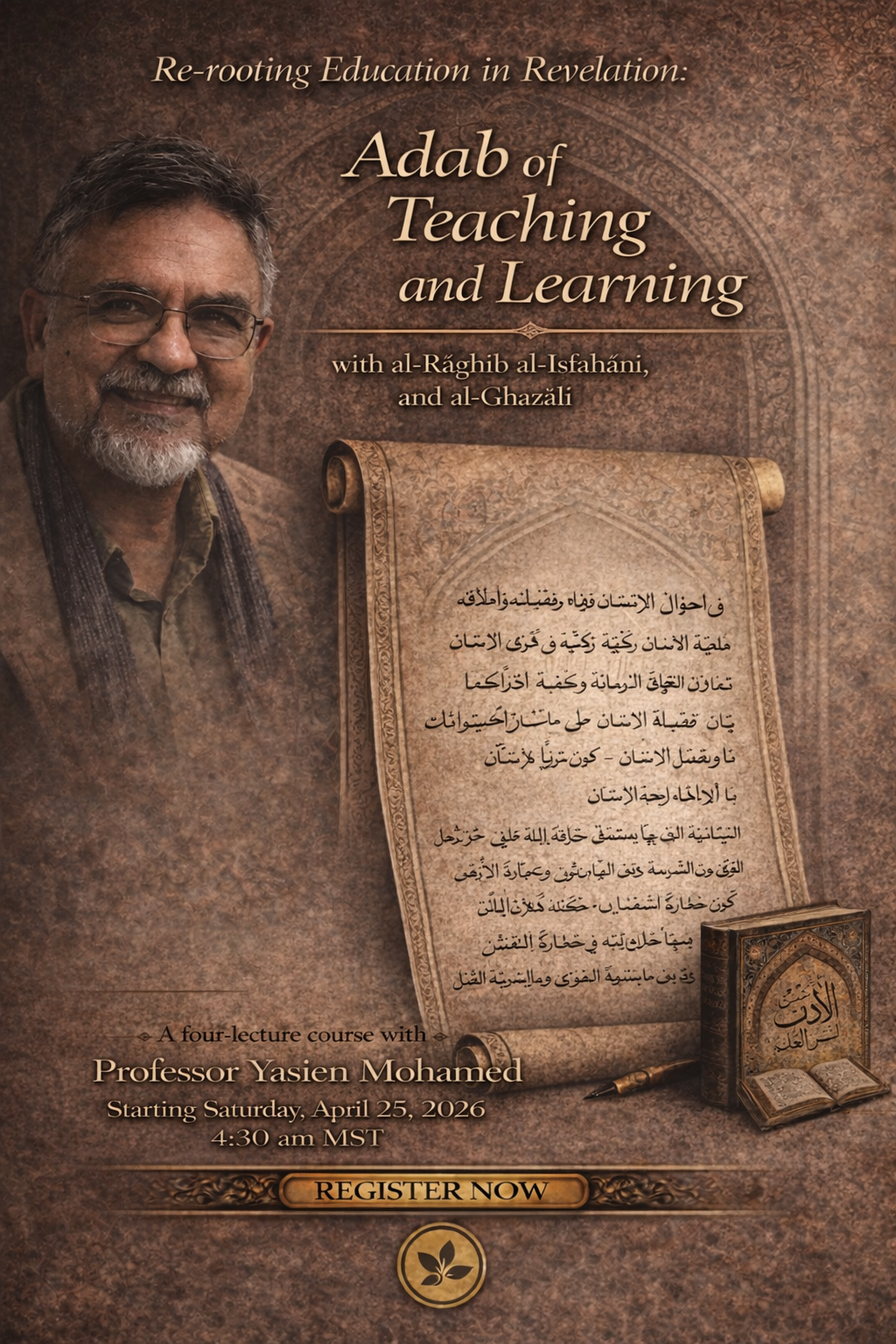
Re-rooting Education in Revelation: Adab of Teaching and Learning
with Rāghib al-Iṣfahānī and al-Ghazālī
A 4-lecture course starting Saturday May 2, 2026 by
Professor Yasien Mohamed
Emeritus Professor of Arabic and Islamic philosophy
University of the Western Cape
Course Overview
This course offers a sustained engagement with the concept of adab as the ethical and epistemic foundation of teaching and learning within the Islamic intellectual tradition. Drawing on the works of al-Rāghib al-Iṣfahānī and Abū Ḥāmid al-Ghazālī, it examines how the processes of learning and instruction are governed not merely by method, but by disciplined character, ordered intention, and a properly articulated hierarchy of knowledge.
At a time when education is increasingly reduced to technique, performance, and the accumulation of information, this course restores a foundational insight of the tradition: that knowledge is transformative only when it is pursued within a framework of adab. The child must be formed before knowledge can be rightly received; the teacher must embody what is taught if instruction is to bear fruit; and knowledge itself must be situated within a hierarchy of ends that directs the learner toward truth, responsibility, and ultimately, nearness to Allah Most High. The primary responsibility rests with parents, in whose care the child is first entrusted; the school follows as an extension of the home.
Designed for educators, scholars, and institutional leaders, this course offers not a set of pedagogical techniques, but a reorientation of the educational enterprise itself. It invites participants to reconsider the conditions under which knowledge is sought, taught, and transmitted, and to recover a model of education in which intellectual clarity, moral discipline, and spiritual purpose are inseparably joined. In doing so, it contributes to the larger task of moving from Muslim schooling to truly Islamic education—where learning is ordered, purposeful, and rooted in tawḥīd.
Lecture 1: The Adab of the Young Learner
Saturday, May 2, 2026
10:00 AM MST | 6:00 PM SAST | 1:30 AM (May 3) ACST
At the heart of the Islamic intellectual tradition lies a unified vision of knowledge and character: the cultivation of the intellect is inseparable from the discipline of the soul. This opening lecture introduces adab as the foundational condition for all meaningful learning—not merely as etiquette, but as a mode of being that orders the self in relation to knowledge, authority, and ultimately, Allah Most High.
Drawing on the ethical and pedagogical writings of al-Rāghib al-Iṣfahānī (d. ca. 431/1040) and Abū Ḥāmid al-Ghazālī (d. 505/1111), this lecture examines the formative stages of the child, where moral discipline precedes intellectual refinement. These scholars articulate a shared vision in which adab is not ornamental but constitutive: it shapes receptivity to knowledge, disciplines desire, and orients the learner toward truth. The child is a young learner; the parents are not-so-young learners, but both are learners as per the Prophetic teachings; we learn from cradle to grave.
Particular attention will be given to the transmission and development of ethical thought from al-Iṣfahānī to al-Ghazālī, especially in works such as Mīzān al-ʿAmal and Iḥyāʾ ʿUlūm al-Dīn, where the cultivation of the self is presented as a precondition for the acquisition of sound knowledge.
In an age marked by distraction, acceleration, and the erosion of formative discipline, this lecture recovers a foundational insight of the tradition: that the crisis of education is, at its root, a crisis of adab. The session invites educators and parents alike to reconsider the earliest stages of formation—not as preparatory, but as decisive—where the habits of the soul determine the trajectory of learning itself.
Lecture 2: The Adab of the Teacher
Saturday, May 9, 2026
10:00 AM MST | 6:00 PM SAST | 1:30 AM (May 10) ACST
If the young learner is shaped by adab, the teacher is the one through whom that shaping becomes possible. In the Islamic tradition, teaching is not a neutral profession but the culmination of a moral and intellectual journey: the one who has sought knowledge, internalized it, and reflected upon it is now entrusted with its transmission. This final stage—imparting knowledge to others—is, as Abū Ḥāmid al-Ghazālī (d. 505/1111) describes, the most noble of all.
Grounded in al-Ghazālī’s Mīzān al-ʿAmal (Chapter “The Duties of the Teacher”)—a work currently being translated by Professor Yasien—this lecture examines the ethical responsibilities that govern the act of teaching. Knowledge, in this account, is not merely to be conveyed but to be embodied; the teacher is likened to the sun that illuminates others, or musk that diffuses its fragrance. Yet if knowledge is not lived, it becomes a liability—like a lamp that burns itself out while giving light to others.
Al-Ghazālī organizes the adab of the teacher into eight governing duties.
The first is compassion: the teacher must treat students as his own children, recognizing that while the father is the means of physical life, the teacher is the means to eternal felicity. The second is sincerity: teaching must not be undertaken for wage, recognition, or worldly gain, but solely for the sake of Allah, lest knowledge be reduced to a servant of wealth rather than its master.
The third duty is moral guidance: the teacher must direct the student toward the ultimate aim of knowledge—the happiness of the Hereafter—while restraining him from pursuits beyond his capacity, and correcting intention without extinguishing the desire to learn. The fourth is pedagogical wisdom: correction should often occur through allusion rather than direct censure, preserving dignity and preventing defiance.
The fifth duty is intellectual generosity: the teacher must not disparage other disciplines, but guide the student through a proper hierarchy of knowledge, ensuring both respect for other sciences and orderly progression within them. The sixth is discernment: knowledge must be imparted according to the learner’s capacity, advancing him gradually from the apparent to the subtle, and withholding what would confuse or harm him.
The seventh duty is restriction and protection: the teacher must prevent the unprepared from engaging prematurely with higher or speculative knowledge, preserving both the integrity of the student and the dignity of knowledge itself.
The eighth and final duty is the most demanding: the teacher must act in accordance with what he teaches. His conduct must confirm his words, for knowledge is received not only through the intellect but through the example of the one who embodies it. A teacher who contradicts his own teaching undermines both knowledge and trust, leading others astray.
Taken together, these duties redefine the act of teaching. Authority is not a function of position, but of integrity; instruction is not measured by delivery, but by transformation. The teacher stands as a guide whose presence disciplines, whose restraint protects, and whose sincerity determines whether knowledge becomes light or burden.
In an educational culture increasingly governed by technique, performance, and institutional metrics, this lecture restores a foundational principle of the Islamic tradition: that the crisis of teaching is not methodological, but ethical. To teach without adab is to misdirect knowledge; to teach with it is to participate in the formation of souls ordered toward truth and ultimately toward Allah Most High.
Lecture 3: The Adab of the Learner: Discipline of the Self and Relation to the Teacher
Saturday, May 16, 2026
10:00 AM MST | 6:00 PM SAST | 1:30 AM (May 17) ACST
Having examined the formative condition of the child and the moral vocation of the teacher, this lecture deepens the inquiry by systematizing the adab of the learner as a disciplined path of self-formation and relational responsibility. Here, learning is no longer understood as mere acquisition, but as a structured transformation of the self in relation to knowledge, authority, and ultimate purpose.
Drawing on the ethical writings of al-Rāghib al-Iṣfahānī and their profound resonance in the works of Abū Ḥāmid al-Ghazālī, this session presents the duties of the learner as a coherent moral framework. While both scholars articulate a comprehensive set of responsibilities, these will be organized into three governing domains: adab toward the self, adab toward the teacher, and adab toward knowledge. The present lecture focuses on the first two, which together establish the inner and relational conditions for sound learning.
The adab toward the self begins with the recognition that the soul must be disciplined before it can receive knowledge rightly. This entails an awareness of the faculties of the self and a commitment to tazkiya—the purification and ordering of one’s inner life. Central to this discipline is zuhd, not as withdrawal from the world, but as a principled detachment from that which distracts from truth. Al-Iṣfahānī’s image of the world as a passing vessel underscores the transience of worldly attachments, while al-Ghazālī frames zuhd as a necessary condition for sincerity and clarity of purpose in the pursuit of knowledge.
The adab toward the teacher establishes the ethical structure of transmission. The teacher is not merely a conduit of information, but a guide whose role concerns the young learner’s ultimate felicity. For this reason, the tradition accords the teacher a rank surpassing that of the parent in a specific sense: the parent sustains temporal life, while the teacher prepares the seeker of knowledge for eternal success. This relationship demands humility, patience, and disciplined receptivity. Al-Ghazālī’s treatment of the encounter between Mūsā (upon him peace) and al-Khiḍr illustrates the limits of unaided intellect and the necessity of restraint before higher knowledge.
Together, these dimensions redefine the learner as an ethical subject whose readiness for knowledge depends on self-mastery and proper orientation toward authority. In an educational climate that privileges access over discipline and information over transformation, this lecture restores a central insight of the tradition: that knowledge yields its fruit only to the one who is prepared to receive it.
Lecture 4: The Adab of the Learner: Adab toward Knowledge
Saturday, May 23, 2026
10:00 AM MST | 6:00 PM SAST | 1:30 AM (May 24) ACST
Having considered the learner’s discipline of the self and proper relation to the teacher, this final lecture turns to the third and culminating dimension of student adab: the learner’s relation to knowledge itself. In the Islamic tradition, knowledge is never neutral, self-justifying, or pursued merely for accumulation. It is ordered, purposive, and inseparable from the moral and spiritual destiny of the one who seeks it.
A central principle of this tradition is that knowledge is hierarchical. Not every branch of learning occupies the same rank, nor does every discipline yield the same fruit. Foundational to the formation of the Muslim learner are those sciences that establish sound belief, right worship, and upright conduct—above all, ʿaqīda and fiqh, not merely as abstract subjects to be studied, but as truths to be embodied in thought and practice. These disciplines provide the normative framework within which all other knowledge receives its proper place.
Yet the aim of learning is not exhausted by correctness of understanding alone. The learner is called to fulfil the trust of vicegerency on earth through the refinement of the soul and the cultivation of noble character. Knowledge must therefore conduce to transformation: by disciplining the self, cultivating justice, compassion, and generosity, and directing the learner toward deeper knowledge of Allah Most High and ultimate felicity in the Hereafter. In this sense, the worth of knowledge is inseparable from the kind of human being it produces.
A second governing principle is that knowledge must be evaluated according to its fruits. The merit of any discipline lies in the good it yields and the end it serves. Medicine, for example, is noble because it preserves bodily life; yet the religious sciences rank above it because they preserve the soul and orient the human being toward eternal success. Other branches of inquiry, including the philosophical sciences, may also possess value—but only when rightly situated within a higher order of ends. They are not pursued as autonomous absolutes, but as subordinate forms of inquiry whose legitimacy depends on whether they clarify, support, or defend truth.
This lecture thus brings the course to its completion by restoring a foundational principle of Islamic education: that the seeker must learn to ask not only whether a thing can be known, but what rank it holds, what end it serves, and what kind of soul it forms. In an age that prizes information without hierarchy and inquiry without telos, this final session recalls the student to a lost discipline—the adab of knowing what knowledge is for.
Required Readings
Abū Ḥāmid al-Ghazālī, Mīzān al-ʿAmal , Dar al-ma’arif, pp. 362-372; 2018, Dar al-Minhaj, pp. 236-252/ Translated by Professor Yasien Mohamed [Provided to the course participants as part of the Course Package].
al-Ghazālī/ T. J. Winter: On Disciplining the Soul [Kitāb riyāḍat al-nafs], 1995, pp. 75-83: “An Exposition of the Way in which Young Children should be Disciplined, and the Manner of their Upbringing and the Improvement of their Characters.” [Provided to the course participants as part of the Course Package]
Recommended Texts
Yasien Mohamed, The Art of Cultivating Noble Character: al-Rāghib al-Iṣfahānī’s Kitāb al-Dharīʿa ilā Makārim al-Sharīʿa. Annotated translation with introduction. White Thread Press, 2024 [Pages 173_178 of the text. “On duties of teacher and student”], provided to the course participants.
Yasien Mohamed, “The Ethics of Education: al-Iṣfahānī’s al-Dharīʿa ilā Makārim al-Sharīʿa as a Source of Inspiration for al-Ghazālī’s Mīzān al-ʿAmal,” The Muslim World 101, no. 4 (2011): 633–657.
Yasien Mohamed, “Etiquette as Spiritual Nourishment: The Adab of the Student according to al-Rāghib al-Iṣfahānī and al-Ghazālī,” Yaqeen Institute for Islamic Research, March 1, 2023.
Yasien Mohamed, “Duties of the Teacher: al-Iṣfahānī’s al-Dharīʿa as a Source of Inspiration for al-Ghazālī’s Mīzān al-ʿAmal,” in Islam and Rationality: The Impact of al-Ghazālī, vol. 1, ed. Georges Tamer (Leiden/Boston: Brill, 2015), 186–206.