
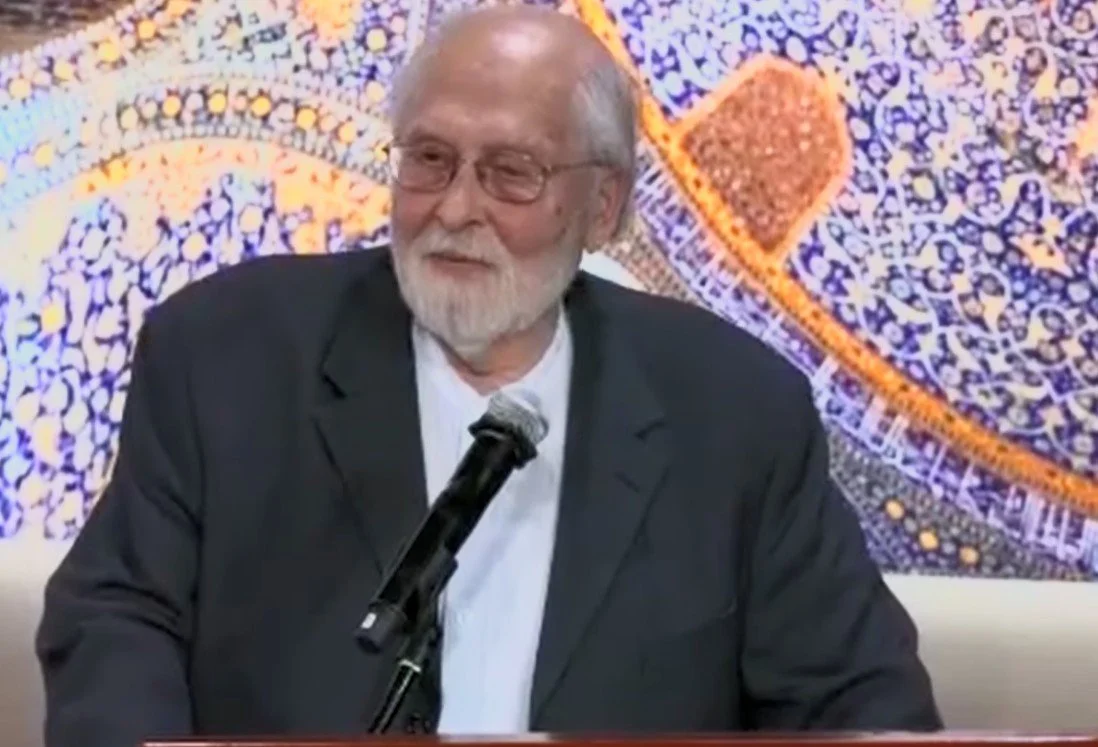
Professor Seyyed Hossein Nasr
At 93, after 70 years of teaching, Professor Seyyed Hossein Nasr offers a unique perspective on teaching science from the Qur’anic Worldview.
This 4-lecture course is designed to provide foundational knowledge as well as practical suggestions.
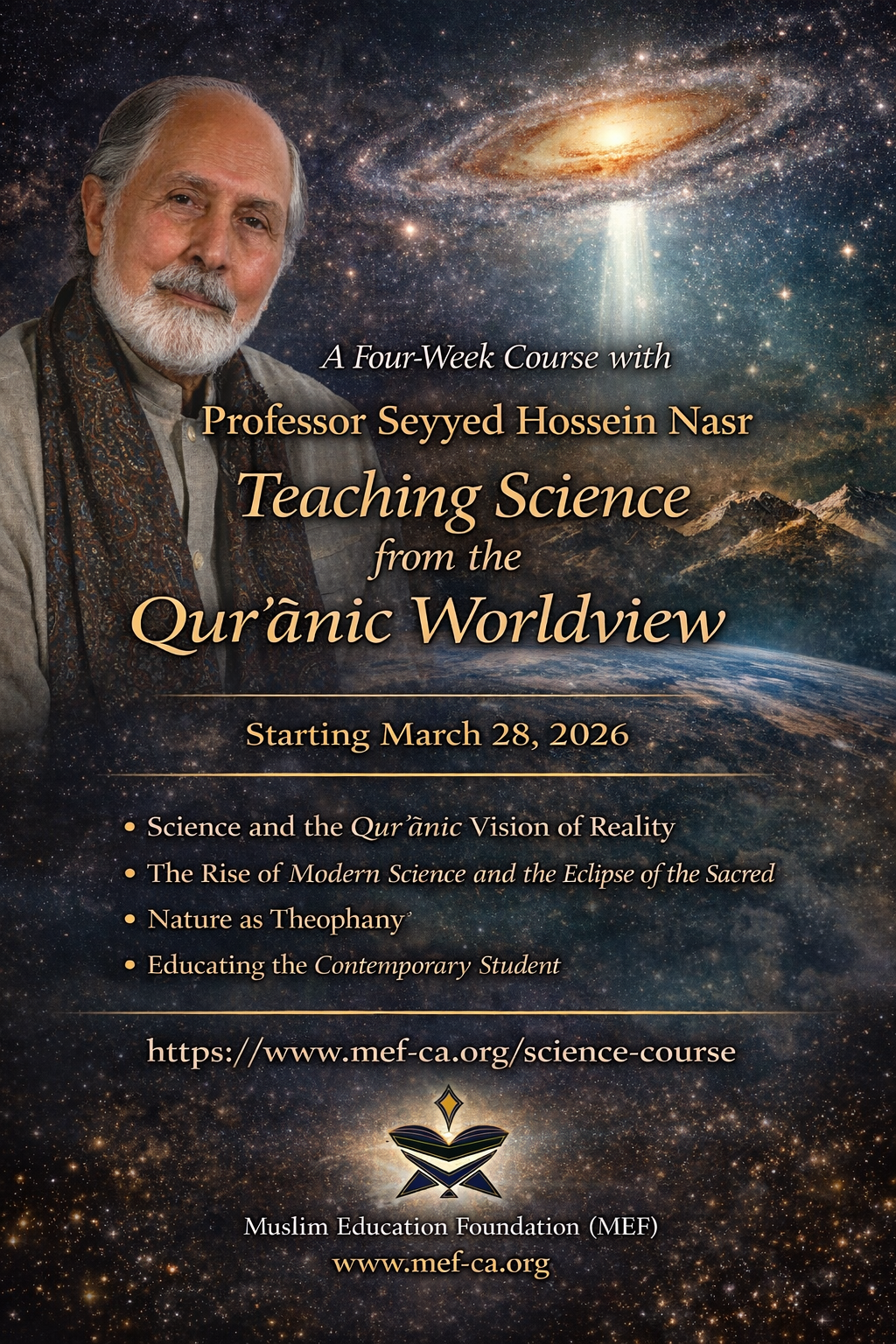
Teaching Science from the Qurʾānic Worldview
Professor Seyyed Hossein Nasr
University Professor Emeritus of Islamic Studies
The George Washington University, USA
Getting Ready
Welcome to the first course in our initiative From Muslim to Islamic Schools
Background knowledge that may be useful to the participants
Registered participants have received Chapter 4 of Dr. Nasr’s book, Religion and the Order of Nature, based on the 1994 Cadbury Lectures he delivered at the University of Birmingham, UK. Please read this chapter: The Traditional Sciences, the Scientific Revolution, and its Aftermath
Note the Opening Reflection
At the beginning of the chapter, Dr. Nasr cites Persian verses that compare the cosmos to a clock—only to reject this comparison and call for a deeper way of seeing…. Click here for the full text of “Getting Ready” and “What to consider while reading this chapter”.
Lecture Titles, Dates and Times
All lectures will be held online on the following dates at 2 pm, EST. They will last 60 minutes.
Time Zone conflicts: If you live in a time zone where it is not possible to attend online, you can still register and have access to the recordings for one year from the date of lecture. Every registered participant will receive a personal link to the recordings.
Saturday, March 28, 2026
Lecture 1: Science and the Qurʾānic Vision of Reality
Metaphysical Foundations of Knowledge
This opening lecture introduces teachers to the Qurʾānic vision of reality as a cosmos structured by meaning, order, and purpose. It will explore the concept of the universe as a field of divine signs (āyāt), the centrality of tawḥīd as the principle of unity in knowledge, and the distinction between sacred science and modern secular science. The lecture will lay the metaphysical groundwork necessary for understanding science not as an autonomous enterprise, but as a mode of knowing that must remain rooted in Revelation and intellect (ʿaql).
Saturday, April 4, 2026
Lecture 2: The Rise of Modern Science and the Eclipse of the Sacred
Historical and Epistemological Rupture
This lecture examines the emergence of modern science in Europe and the gradual loss of metaphysical and spiritual dimensions in the study of nature. It will address the transformation of science from a contemplative pursuit into a purely quantitative and utilitarian discipline, highlighting the philosophical assumptions—often unexamined—that now govern scientific education. Teachers will be guided to recognize how this rupture affects contemporary classrooms and how it contrasts with the Islamic intellectual tradition.
Saturday, April 11, 2026
Lecture 3: Nature as Theophany
Teaching the Natural Sciences within a Sacred Cosmos
Focusing on pedagogy, this lecture articulates how the natural sciences—physics, biology, chemistry, and cosmology—can be taught within a worldview that recognizes nature as theophany (tajallī), not brute matter. Drawing upon Islamic cosmology and traditional perspectives on nature, the lecture will offer conceptual guidance for helping students see scientific laws as expressions of divine order rather than as substitutes for meaning. Emphasis will be placed on cultivating intellectual reverence, humility, and wonder in the science classroom.
Saturday, April 18, 2026
Lecture 4: Educating the Contemporary Student
Science, Ethics, and the Formation of the Human Being
The concluding lecture addresses practical issues dealing with teaching of science to the contemporary Muslim students. We will ask you to send your questions in advance and Dr. Nasr will provide strategies, insights, and practical ways to integrate the Qurʾānic Worldview into your teaching of science. Answering questions such as:
But I have to teach what the Department of Education requires
How do I infuse my teaching of science with what you have advocated all along within the time I have?
What do we do with modern cosmology? Evolution?